grinding
It Does Not Stop the Clenching
Four signs answer it, and none of them is noise. A guard does not stop the clenching — it decides whether the damage lands on plastic or on enamel.
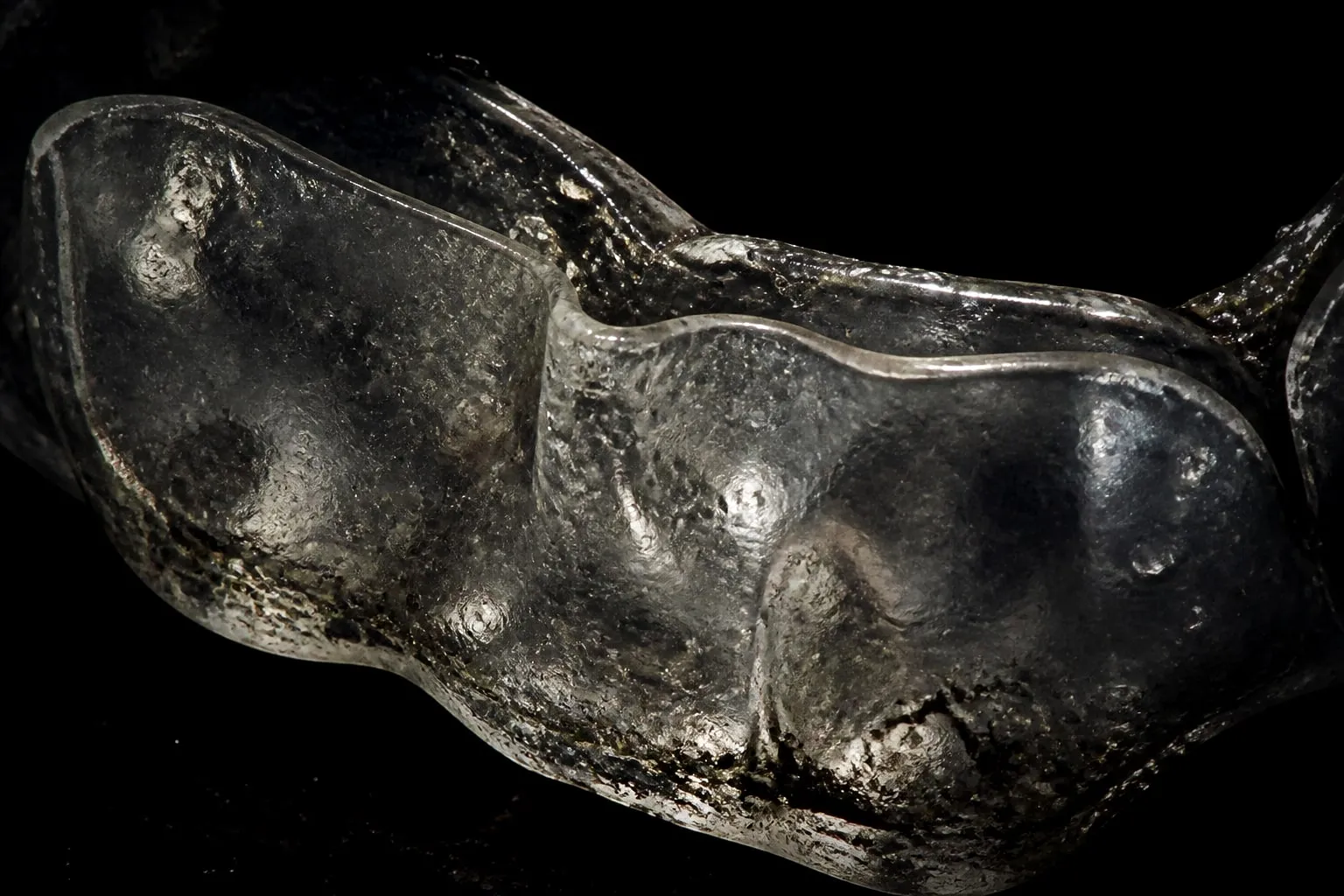
Most people ask this question because somebody told them they grind. That is the least reliable sign on the list, because it only catches the people who make noise — and clenchers, who do most of the damage, are silent.
The four signs that actually answer it
A tight or aching jaw on waking. Worse in the morning and easing through the day is the pattern. Clenching for hours is sustained isometric muscle work, and the muscle is stiff afterwards the way any muscle is.
Headaches on waking. Specifically present when you wake rather than building through the day. The temporalis muscle fans across the side of the skull, so hours of clenching produces a band of pain around the head that is routinely treated as migraine for years.
Flattened, chipped or worn edges. Look at the biting edges of the front teeth. If they are flat and level rather than gently varied, that is wear. Small chips at the edges point the same way.
New sensitivity to cold, particularly at the gum line, often together with small notches where tooth meets gum. Clenching flexes the tooth at the neck, which damages enamel exactly there.
Any two of those is a strong case. And most people find out the way this person did:
I’m booked in for a crown next month, I didn’t actually notice it, my dentist caught it during a check-up, I wouldn’t have know haha r/bruxism
What a guard does, precisely
It does not stop you clenching. The nervous system carries on exactly as before.
What it does is put a replaceable object between the two arches.
The force lands on plastic instead of enamel. A guard wears down and gets replaced. Enamel wears down and stays worn.
It spreads the load. Instead of two opposing cusps meeting at a point, the force is distributed across a surface, which is why cracked cusps are much less common in people wearing one.
And it stops the shearing. Grinding is lateral, and lateral force is what enamel handles worst. A smooth surface lets the jaws slide instead of catching tooth on tooth.
Which is why it is a cheaper object than the crowns it prevents:
Have had 2 crowns in 2 years on the same cracked tooth r/bruxism
And the honest caveat
It does not always feel better, and people say so:
It makes mine worse for some reason but it protects my teeth so I wear it. r/bruxism
That is a fair report and worth taking seriously. A guard that is too thick, or unbalanced so that some teeth contact before others, can increase muscle activity rather than settling it.
If a guard makes the jaw worse, the response is to have it adjusted or remade, not to give up on the idea. The teeth are still being protected while the muscle problem is worked on, which is why that person kept wearing theirs.
Guard, or the thing underneath
The guard protects hardware. It does nothing about why you are clenching, and for jaw pain specifically that distinction matters:
My dentist said that I have both - but that in my case it’s the bruxism that causes the pain to be so bad (and from my history appears to have caused the TMJ), and that treating the bruxism will lessen the tmj symptoms r/bruxism
So the full answer usually has two halves.
The guard, for the teeth.
And whatever is driving it, for the muscles and joint — stress and sleep quality, medication side effects (several antidepressants increase bruxism), alcohol and caffeine in the evening, and sleep apnea, which is strongly associated with night-time grinding and is the one worth ruling out because it has consequences well beyond teeth.
Somebody describing how far it can go:
I wake myself up every morning by extreme tooth grinding. A crown came loose and I cracked two other teeth r/bruxism
That situation needs both halves. A guard alone is holding a line.
Which guard
Custom, made from an impression, is the right answer for anybody wearing one long-term. It fits the bite rather than sitting on top of it, it is thinner, and it lasts.
Boil-and-bite from a pharmacy is a legitimate way to test whether a guard helps before spending on a custom one. Bulky, wears through in months, and a badly fitting one can allow teeth to shift — so it is a trial rather than a solution.
Hard versus soft is a genuine debate. Soft is more comfortable and some people chew it, which can increase muscle activity. Hard acrylic is more durable and more commonly recommended for heavy grinders. Worth discussing rather than assuming.
Upper or lower matters less than people think, and comes down to gag reflex and comfort.
What it will not fix
Wear that has already happened. Enamel does not regrow, and a guard prevents further loss rather than restoring what is gone. Which is the argument for getting one at the first sign rather than after the crowns.
The short version
Four signs: a tight jaw on waking, headaches on waking, flat or chipped edges, new sensitivity at the gum line. Noise is optional.
The guard does not stop the clenching. It decides whether six hours of force a night lands on plastic you replace or on enamel you do not.
And it is half the answer. The other half is why you are clenching, which is worth asking about — particularly if you snore.
Questions people actually ask
How do I know if I need a night guard?
Four signs. Waking with a tight or aching jaw, headaches on waking rather than developing through the day, flattened or chipped tooth edges, and teeth that are newly sensitive to cold. Somebody hearing you grind is confirmation, not a requirement.
Does a night guard stop grinding?
No, and this is the most misunderstood part. The muscle activity continues exactly as before. What changes is where the force lands — on a replaceable piece of plastic instead of on enamel that does not grow back.
Are cheap boil-and-bite guards any good?
As a short test of whether a guard helps, yes. As a long-term appliance, no — they are bulky, they wear through quickly, and a poorly fitting one can allow teeth to move. A custom guard fits the bite rather than covering it.
Can a night guard make things worse?
Occasionally, and people report it. A guard that is too thick or badly balanced can increase muscle activity. If a guard makes the jaw worse rather than better, that is a reason to have it adjusted, not to abandon the idea.