weird
The Pole Was an Advertisement for Surgery
The stripes are blood and bandages. For centuries the man who cut your hair also pulled your teeth, and the pole outside was the advertisement.
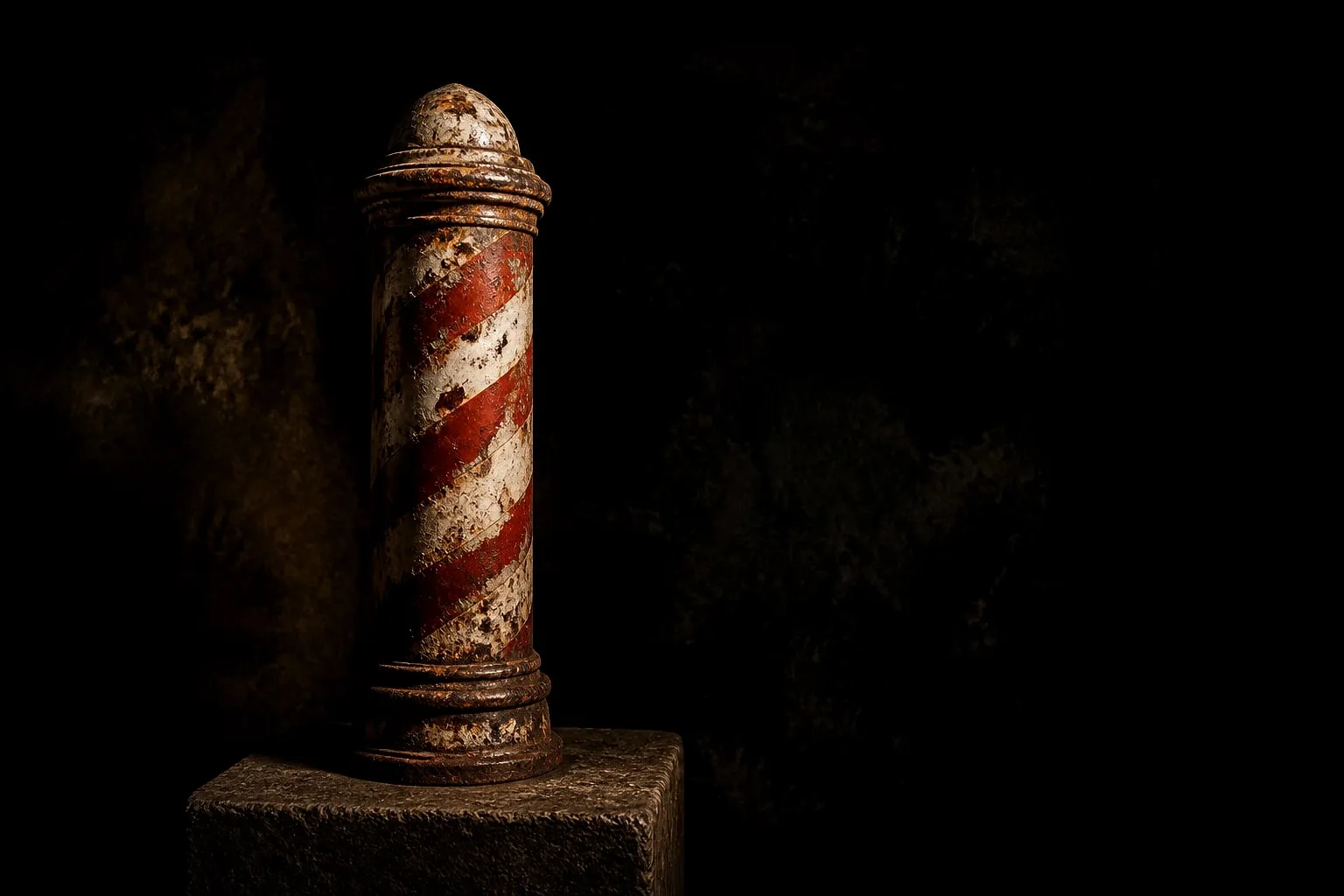
The stripes are not decoration. They are blood and bandages.
For most of European history, the man who cut your hair also pulled your teeth.
Why the barber, of all people
The barber had two things nobody else on the street had: a very sharp blade and the daily practice of using it on a stranger’s face.
That turned out to be the entire qualification. When a tooth had to come out, or an arm had to be bled, or a boil had to be opened, the person with the razor was the obvious choice.
There was a second reason, and it is the odd one. Much of this work had previously been done in monasteries, and the clergy who did it were increasingly discouraged from shedding blood. The work did not disappear. It moved down the street to the man who already had the tools.
So the barber inherited it. Shaving, haircutting, bloodletting, lancing, and extraction — one trade, one shop, one set of instruments.
What the pole actually shows
The pole is a working object, not a symbol invented later.
The red is blood. The white is the linen bandage wrapped around the arm afterwards. And the pole itself is the staff the patient gripped to make the veins in the arm stand out while the blood was let.
When the shop was closed, the bandages were washed and hung on that staff outside to dry. They twisted in the wind around the pole, red and white together — and eventually somebody stopped washing real linen and simply painted the pattern on.
The advertisement had become the sign.
The trade had a name and a guild
This was not an informal arrangement. It was a recognised profession with a recognised name: the barber-surgeon.
In England the two crafts were formally joined in 1540, when Henry VIII united the Barbers’ Company and the Guild of Surgeons into a single body. The union came with a division of labour written into it — a working boundary between the men who shaved and the men who cut deeper.
It held for two centuries.
The split, and then the dentists
In 1745 an act of Parliament separated them again. The surgeons left to form their own company, which in time became the Royal College of Surgeons of England. The barbers kept the razors, the shop, and the pole.
Dentistry took its own road out of the same shop, and it took longer.
The book usually treated as the turning point is Pierre Fauchard’s Le Chirurgien Dentiste, published in 1728 — the first attempt to set out the treatment of teeth as a subject in its own right, with its own methods, rather than as one job among many performed by a man with a blade.
From there it becomes a profession: training, then licensing, then schools.
What survived
Almost nothing of the trade remains. The bloodletting is gone, the lancing is gone, the extractions moved to a different building entirely.
The pole stayed.
It is one of the oldest continuously used commercial signs in the world, still turning outside shops where the most invasive thing that happens is a fade. Nobody who sees it thinks about blood, which is precisely why it survived — the meaning fell away and the shape kept working.
The short version
The barber had the sharp blade, so the barber got the surgery — including the teeth. The pole outside advertised it: red for blood, white for the bandages, wound around the staff patients gripped while being bled.
England joined the two trades officially in 1540 and separated them in 1745. Dentistry left the same shop by a different door, and the book that pushed it out was published in 1728.
The barber kept the pole. It is still spinning, and it still means what it meant.
Questions people actually ask
Why is the barber pole red and white?
The red stands for blood and the white for the bandages used to bind the arm afterwards. Barbers performed bloodletting for centuries, and the pole was the sign outside the shop that advertised it.
Did barbers really pull teeth?
Yes, routinely. Pulling a tooth was one of the standard services alongside shaving, haircutting and bloodletting, and for most of Europe the barber was the person you went to when a tooth had to come out.
When did dentists stop being barbers?
The split was gradual. In England the barbers and surgeons separated by act of Parliament in 1745, and dentistry became a distinct profession over the following century.
Why did barbers do surgery at all?
Because they already owned sharp blades and had steady hands, and because the clergy who had previously done such work were discouraged from shedding blood. The tools were the qualification.