weird
A Jaw Grows. A Tooth Cannot.
Because a jaw grows and a tooth cannot. Twenty small teeth fit a child's head, thirty-two adult ones do not, and there is no way to resize enamel.
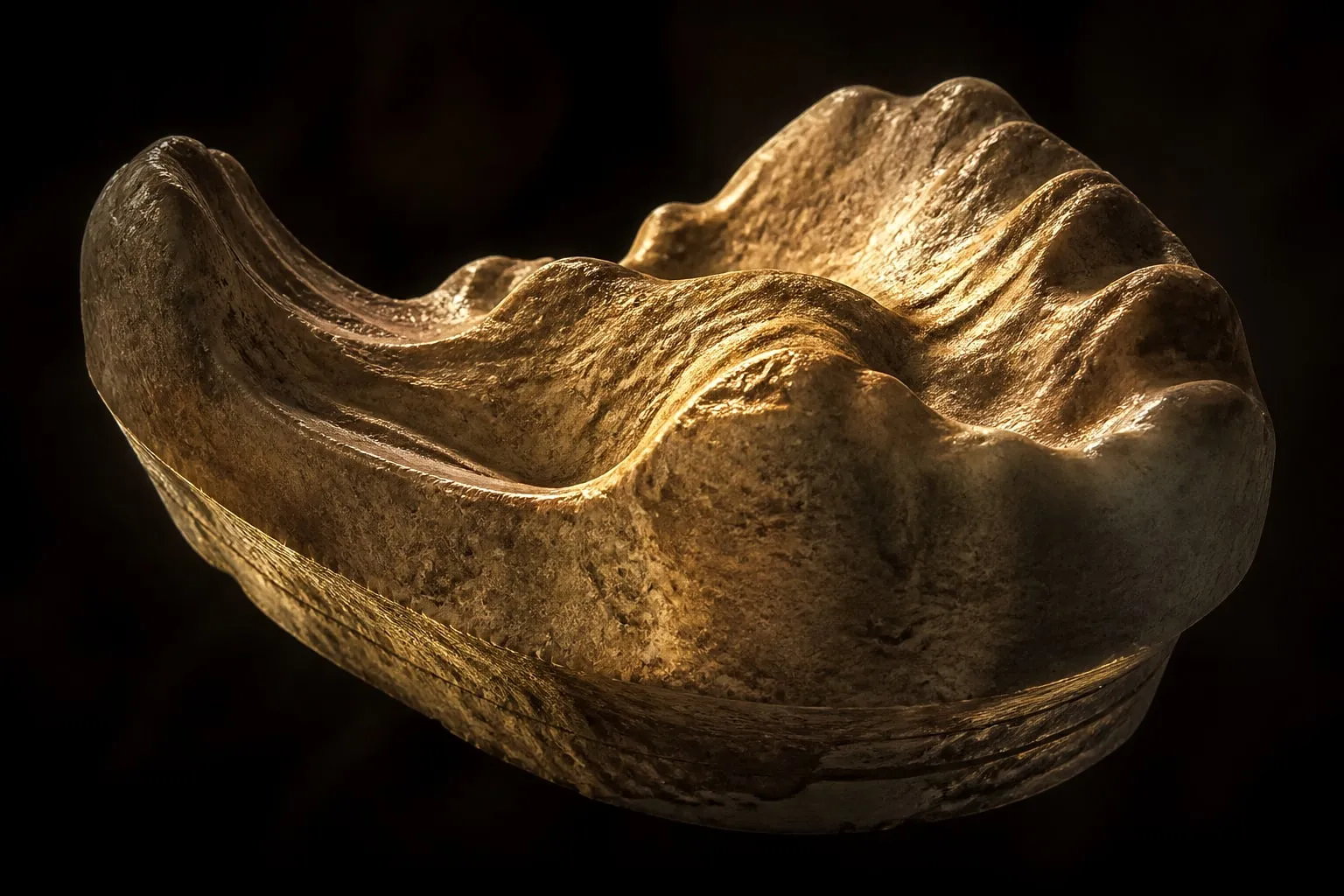
Every child loses their teeth and nobody finds it strange. It is strange, and the reason is a constraint no engineer would accept.
Enamel is finished when it is finished
A tooth is not living tissue in the way a bone is.
Bone remodels continuously — it is dismantled and rebuilt throughout life, which is how it grows, heals a fracture and adapts to load.
Enamel does none of that. It is made once, by cells that then die and are shed as the tooth erupts. From that moment there is no mechanism to add to it, reshape it, or make it larger. What you have is what was built.
Which produces the problem. A newborn jaw is a fraction of the size of an adult one. A tooth built to fit an adult jaw physically will not fit in a child’s head, and a tooth built to fit a child cannot be enlarged later.
So you need two sets, and the changeover has to happen while the jaw is growing.
Which is what the six years are for
Baby teeth are not a rehearsal. They do two jobs.
Chewing, for about six years. A child needs functional teeth from roughly age one, and the adult set is not ready until six at the earliest and not complete until twelve.
And holding the space. Each baby molar occupies the exact position its permanent replacement has to arrive into, keeping the neighboring teeth from drifting inward. This is the underrated one — a baby tooth lost early lets the arch close up, and the adult tooth arrives to find its space partly gone.
There are twenty of them and thirty-two of the adult set. The extra twelve are the molars at the back, which erupt into space created by the jaw lengthening rather than replacing anything. The first permanent molar comes in behind the baby teeth at around six, and most parents never realize a permanent tooth has arrived because nothing fell out to announce it.
How a tooth pushes another one out
Not by force from below, which is what the intuition suggests.
The permanent tooth develops in the bone beneath its predecessor and releases signals that recruit osteoclasts — the cells that dissolve bone. Those cells dissolve the root of the baby tooth above them.
So a baby tooth does not get pushed out. It is eaten from underneath. By the time it comes loose, the root has been almost entirely resorbed, which is why a shed baby tooth is a small crown with nothing beneath it and almost no bleeding.
That’s a demolition process running on a schedule, tooth by tooth, for six years.
Why we can’t have a third set
We are diphyodont — two generations of teeth. Most reptiles and fish are polyphyodont and replace them for life.
The difference is a strip of tissue called the dental lamina. It is the band of embryonic cells from which tooth buds form, and in continuously replacing animals it persists, producing a new generation whenever the previous one wears out.
In humans it makes the baby set, makes the permanent set, and then breaks down. Nothing is left to start a third.
Which is a curious thing to lose, because the rest of the machinery survives. The signalling pathways that build a tooth are still present and still functional, which is exactly why laboratories working on tooth regrowth are attempting to reawaken them rather than build something new.
That some people grow extra teeth — supernumeraries, or a fourth molar behind the third — shows the capacity has not gone. It just isn’t scheduled.
What other mammals do instead
Mammals largely gave up replacement in exchange for precision.
A reptile’s teeth are more or less interchangeable pegs, so losing one costs little. A mammal’s teeth interlock — upper and lower cusps meet in a specific arrangement that allows grinding rather than only gripping, which is what makes it possible to extract enough energy from food to run a warm body.
That precision is incompatible with constant replacement. A tooth arriving into a precisely matched set would disrupt it. So mammals settled on two generations and made the second one durable.
The exceptions are instructive. Elephants and manatees keep replacing molars, but not from underneath — new teeth form at the back and the whole row migrates forward, worn teeth falling off the front. It is a conveyor belt rather than a replacement, and it exists because both animals eat abrasive vegetation that would otherwise destroy a fixed set.
An elephant gets six sets that way, and when the last one wears out it starves. Which is an unusually blunt illustration of the design trade.
The bet we made
Two sets, thirty-two teeth, no third chance, and a material that cannot repair itself.
It works because enamel is extraordinary — hard enough that a set can grind for eighty years — and because the second set arrives after the jaw has stopped growing, so it never has to be resized.
And it is a bet, of the kind evolution makes when the alternative costs more. Given eighty years, the arrangement is fine. Given a hundred, with sugar, it isn’t quite, and we invented dentistry to cover the gap.
The short version
A jaw grows and a tooth cannot, so a child needs a small set that gets replaced once the growing is finished.
The baby teeth are dissolved from below by the permanent ones, which is why they come out as crowns with no roots.
And the reason there is no third set is that the strip of tissue that makes teeth breaks down after the second one. The machinery is still there. Nothing is left to switch it on.
Questions people actually ask
Why do humans have two sets of teeth?
Because enamel cannot grow after it forms. A child's jaw is too small for adult-sized teeth, and a tooth cannot be enlarged later, so the only solution is a small temporary set that is replaced once the jaw has finished growing.
Why can't we grow a third set?
We have the genetic machinery — the signals that build a tooth are still present — but the dental lamina that would start a third generation breaks down after the permanent teeth form. Most reptiles keep it and replace teeth for life.
Why do we have baby teeth at all if they fall out?
A child needs to chew for six years before the adult teeth arrive, and the baby teeth also hold the exact space each replacement has to erupt into. Losing one early is one of the more common reasons a child ends up in braces.
Which animals replace teeth continuously?
Most reptiles and fish, including sharks and crocodiles, which replace teeth throughout life. Among mammals it's rare — manatees and elephants move teeth forward along the jaw as they wear, which is a different solution to the same problem.