weird
A Snail Beats a Shark, and It Isn't Close
Not the shark. A garden snail carries around 14,000 teeth, some species over 20,000, and they sit on a tongue that works like a conveyor belt.
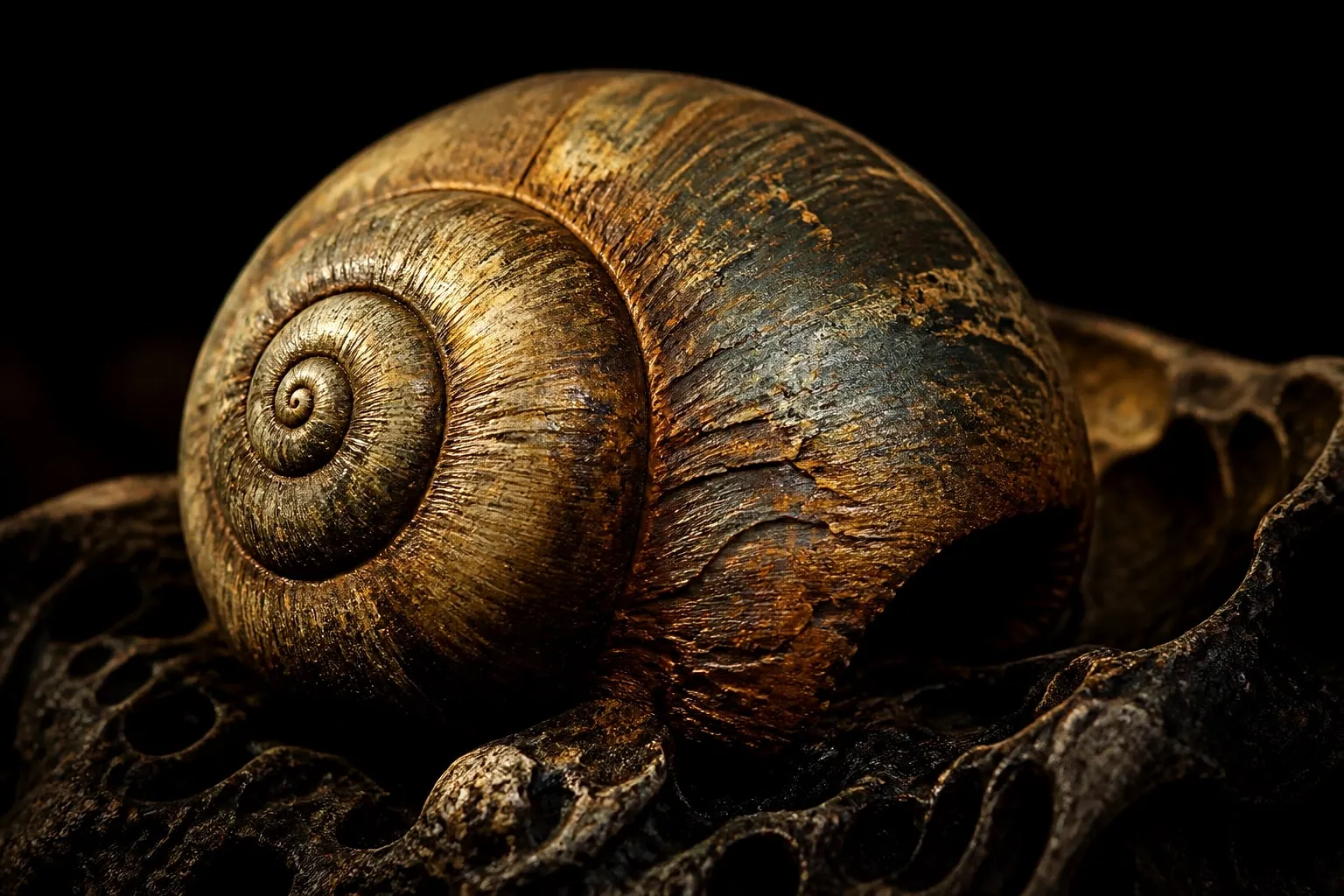
Ask this question and almost everybody says shark. It’s the wrong answer by an enormous margin, and the right answer is in your garden.
A garden snail has about 14,000 teeth
Not in rows in a jaw. On its tongue.
Snails and slugs feed with a radula — a flexible ribbon covered in thousands of microscopic teeth made of chitin, the same material as an insect’s shell. The animal presses the ribbon against a surface and drags it, and the teeth rasp material off like a file.
A common garden snail carries somewhere around 14,000 of them. Some marine species carry more than 20,000. The record-holders in the group run higher still.
If you have ever heard a snail eating a lettuce leaf in a quiet room, that faint scraping is the radula working.
And it’s a conveyor belt
The genuinely elegant part: the radula is consumable.
Teeth at the front wear down and break off. New ones are produced continuously at the back and move forward to replace them. The whole ribbon migrates across the animal’s life, and a snail will get through several complete sets.
Which is a strategy vertebrates never evolved. Humans get two sets — twenty baby teeth, thirty-two adult ones — and when the second set is gone, that’s the end of the supply. A snail’s answer to wear is production.
The shark answer, for the record
Sharks are still remarkable, just not in the way the trivia claims.
At any moment a shark has roughly 30 to 50 teeth in the working row, with several replacement rows lying flat behind them in the jaw. As a front tooth is lost, the row behind rotates forward.
Over a lifetime that can add up to 30,000 or more shed teeth — which is where the confusing number comes from. It is a lifetime total, not a count of what’s in the mouth.
The shark’s innovation is the same one as the snail’s, arrived at separately: teeth as a renewable supply rather than a fixed allocation.
The strongest teeth belong to something smaller still
While we’re here, the strength record is not held by anything with a jaw.
Limpets — the small conical molluscs clamped onto rocks at the shoreline — have radula teeth reinforced with fibers of goethite, an iron-bearing mineral. When researchers at Portsmouth measured them, they came out as the strongest known biological material, beating spider silk for tensile strength relative to size.
Which follows from the job. A limpet scrapes algae off bare rock, all day, for years. A tooth that isn’t harder than granite doesn’t last the morning.
Some numbers for comparison
Snail: ~14,000, on a belt, replaced continuously.
Limpet: a few hundred, and the toughest biological material yet measured.
Shark: 30 to 50 in use, 30,000+ over a life.
Crocodile: around 60, replaced up to 50 times each — roughly 3,000 in a lifetime.
Dolphin: up to about 250 in a long jaw, and none of them replaced. One set, for life.
Snail again, for scale: more teeth than a dolphin, a crocodile, a shark and a human combined, in an animal that fits inside a matchbox.
Human: 32, once, and then nothing.
Which puts the human arrangement in perspective
Two sets and no third is an unusual bet for an animal to make. It works because our teeth are protected by enamel — a mineral shell far harder than chitin, hard enough that with reasonable care a set lasts eighty years.
The trade is that the shell cannot be repaired. A snail’s tooth wears out and is replaced from behind. Ours wears out and stays worn.
So the snail has thousands of disposable teeth and the human has thirty-two permanent ones, and each strategy solves the same problem from opposite directions. Only one of them requires the animal to think about it.
The short version
Snails, by a wide margin — around 14,000 on a tongue that works like a belt sander, replaced continuously from behind.
Sharks get the credit because 30,000 sounds like a count and is actually a lifetime tally.
And the toughest teeth in nature belong to a limpet scraping algae off a rock, which is a job description that explains everything about them.
Questions people actually ask
Which animal has the most teeth?
Snails and slugs. A common garden snail carries roughly 14,000 teeth on its radula, and some marine species exceed 20,000. Sharks, the usual answer, have a few dozen in use at a time and get through tens of thousands over a lifetime.
How many teeth does a shark have?
Around 30 to 50 in the working row at any moment, with several replacement rows behind them. Over a lifetime a shark may shed 30,000 or more, but they are never all in the mouth at once.
What is the strongest tooth material in nature?
Limpet teeth. They are reinforced with goethite fibers and were measured as the strongest known biological material, stronger for their size than spider silk.
Do snail teeth wear out?
Constantly. The radula is a belt that grows from the back and is worn away at the front, so a snail replaces its whole set several times over its life.