braces
Everybody's Move. Yours Are Not Special.
Everybody's do. The lower front teeth crowd inward through your thirties and forties whether or not you ever had braces, and wisdom teeth are not the cause.
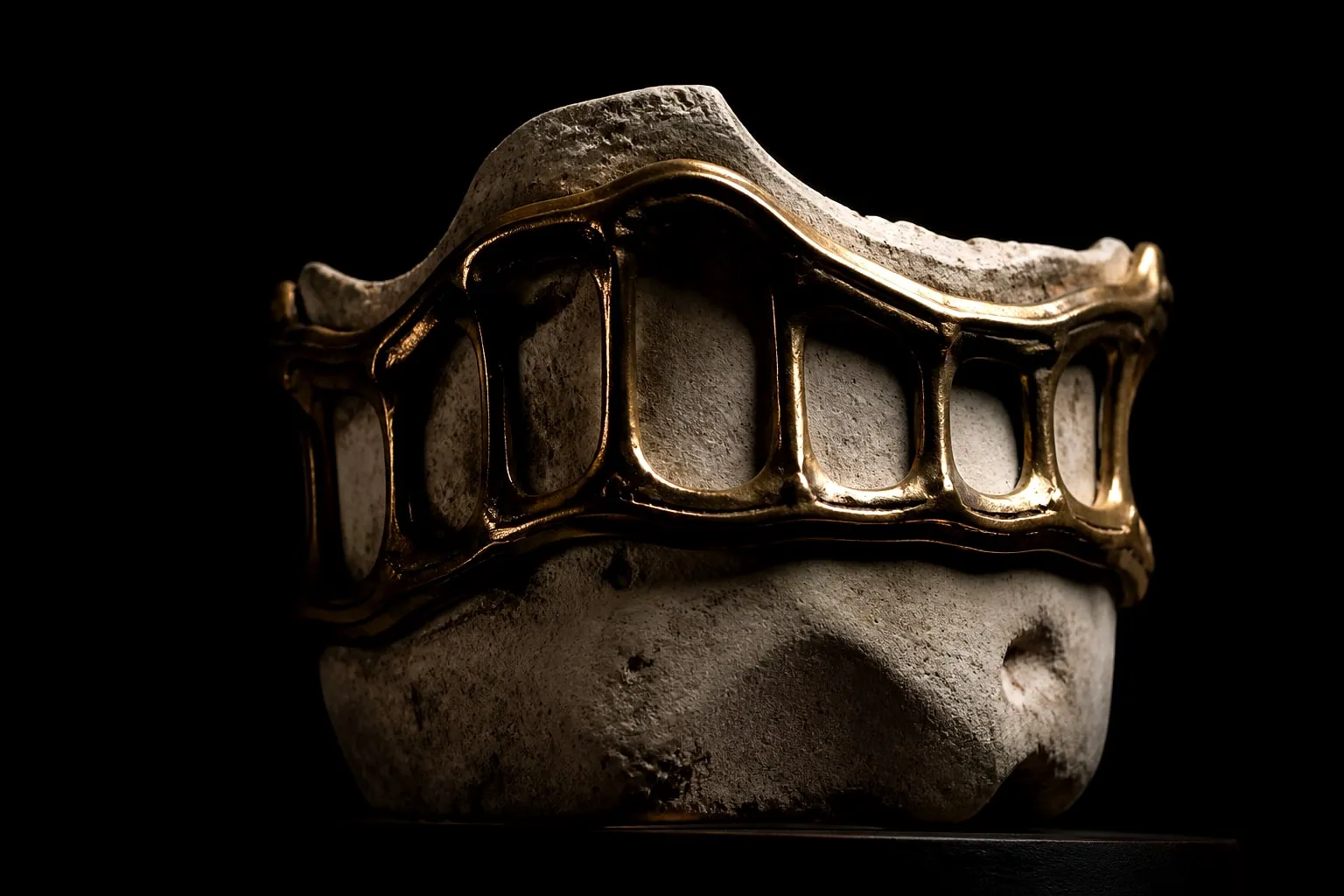
People notice it in their thirties. The bottom front teeth, which used to be straight, have begun to overlap.
The usual assumptions are that the wisdom teeth are pushing, or that the braces failed. Both are mostly wrong, and the real explanation is stranger: teeth were never fixed in place to begin with.
A tooth is not set in bone
It feels rigid, and it isn’t.
Each root sits in a socket, suspended by the periodontal ligament — a few tenths of a millimeter of fibrous tissue running between root and bone. That ligament is alive, richly supplied with blood and nerves, and it is doing two jobs.
It cushions. Chewing force is transmitted through a shock absorber rather than directly into bone.
And it remodels. Sustained pressure on one side of a tooth triggers cells to dissolve bone ahead of it and build bone behind it. The tooth moves.
That is not a defect. It is the entire mechanism orthodontics uses. Braces do not force teeth through bone; they apply a light continuous pressure and the body relocates the socket.
Which means the machinery for moving teeth is permanently switched on, in everybody, for life.
So the question is what pushes
Several things, all day, forever.
The lips and cheeks push inward. The tongue pushes outward. A tooth sits at the equilibrium between them, and that balance shifts as muscle tone and lip posture change with age.
Chewing forces have a forward component. Every bite nudges the arch slightly toward the front, and over decades the front teeth are pressed together and have nowhere to go but around each other.
The lower jaw keeps growing, very slightly, for decades — a small continued rotation that concentrates pressure at the front.
And bone density and gum support change with age, which alters how readily a tooth responds.
The result is called late lower incisor crowding, and it is one of the most predictable things in dentistry. It happens to people who had braces, people who never did, and people whose teeth were beautifully straight at twenty.
Which is why the wisdom tooth theory won’t die
It is intuitively perfect. Teeth erupt at the back, everything shifts forward, the front crowds.
It just doesn’t hold up. Late crowding occurs at similar rates in people who never developed wisdom teeth at all — and a fifth to a quarter of the population is missing at least one — and in people who had all four removed at eighteen.
If wisdom teeth were the engine, those groups would be spared. They aren’t.
There may be a small contribution in some individual cases. As the general explanation, it has been examined repeatedly and does not survive.
What this means about retainers
The uncomfortable conclusion follows directly.
If teeth move because a live ligament responds to continuous force, and that force never stops, then there is no stable end state to arrive at. There is only a result being held against a load.
A retainer is not a recovery period after treatment. It is the counterweight, and it is needed for as long as the force exists — which is permanently.
That is why orthodontists say nightly, forever, and why it sounds like an upsell and isn’t. The alternative isn’t stability. It’s slow drift back toward the arrangement the muscles prefer.
And a bonded wire behind the front teeth is not the complete answer either. It holds the teeth it is glued to. The molars behind it are on their own.
The version that is not normal
Everything above describes slow inward crowding of the lower front teeth over decades.
Different, and worth acting on:
Teeth that suddenly loosen. Movement you can feel with a finger, developing over months rather than decades.
Teeth splaying outward, or new gaps opening between front teeth that used to touch. This pattern — flaring rather than crowding — is characteristic of bone loss, because a tooth with less bone holding it migrates under normal chewing force.
A bite that has changed, so that teeth meet differently than they used to.
Those describe periodontal disease, and the mechanism is the same ligament and bone system working with less support. It is not a cosmetic issue and it does not stop on its own.
The distinguishing test is speed. Decades of slow crowding is aging. Months of visible change is a message.
What to actually do
Wear the retainer, if you have one. Nightly, indefinitely, and replace it when it cracks rather than abandoning it.
Get one made if you never had braces, if the crowding bothers you and is still mild. It holds what is there and costs a fraction of treatment.
Have the gums checked if anything is loosening, splaying or gapping. Pocket depths and an X-ray settle it.
And accept the slow version, because the alternative is a lifetime of intervention against a process that happens to everybody. Slightly overlapping lower incisors at forty are not a failure of anything.
The short version
Teeth hang in a living ligament that rebuilds bone in response to pressure. That system never switches off, and lips, tongue and chewing never stop pushing.
So everyone’s teeth crowd inward at the front over decades, whether or not they ever had braces, and whether or not they ever had wisdom teeth.
Retention is not a phase. It is a counterweight. And anything that loosens, splays or gaps over months rather than decades is a different problem entirely.
Questions people actually ask
Why do teeth shift with age?
Because they were never fixed in place. Each tooth hangs in a ligament that continuously remodels the bone around it, so teeth respond to whatever forces act on them — lips, tongue, chewing — for as long as you have them.
Do wisdom teeth cause front teeth to crowd?
Largely no. Late lower crowding happens at similar rates in people who never developed wisdom teeth and in people who had them removed at eighteen. It's the most persistent orthodontic myth.
Can you stop your teeth from shifting?
Only by wearing a retainer, indefinitely. There is no permanent state to return to — retention is not a phase after treatment, it's the counterweight that holds the result against a force that never stops.
Is shifting a sign of gum disease?
It can be, and this is the version to take seriously. Teeth that suddenly loosen, splay outward, or develop new gaps are showing bone loss, and that is different from the slow inward crowding that happens to everyone.